4-H Record Books

4-H Record Books

2026 Record Books DUE September 30th, 2026. Drop off at the CCEDC Farm & Home Center.
Why are Project Record Books Important?
By keeping a project record book, 4-H members will learn, practice, and share the following skills:
How to make plans for action, and how to decide how well they did (self-evaluation);
Record keeping and organization to use now and in the future;
To communicate and summarize information;
Responsibility by completing a task; and
To evaluate information that will market personal skills through future resumes and application forms.
EVERY RECORD BOOK WILL HAVE TWO PARTS.
- The 4-H member’s specific project/interest area(s) (Project Pages)
- A section everyone will complete regardless of project area(s) (Core Pages)
RECORD BOOK CHECKLIST- Make sure your record book has everything it need!
What are the “Project Pages”?
These are the pages designed by the species or interest area advisories that help to track and report on the project(s) 4-H members work on throughout the year. If 4-H members belong to multiple clubs, they will need to complete the project pages that are relevant to each club.
What are the “Core Pages”?
These pages are for 4-H members to track and report on more general things that they do in 4-H like public presentations, community service and other fun 4-H activities. There are three levels to choose from that vary in difficulty. Each member will choose the level that is appropriate for their abilities and complete one copy of the core pages for their record book.
Level 1: The easiest level and is aimed at younger 4-H’ers (5-7 years old)
Level 2: This level is more challenging than Level 1 (8-12 year olds)
Level 3: This is the most challenging level and is aimed at the older, more experienced 4-H’ers.(Youth ages 13 and up)
Note: 4-Her’s who feel the level for their age group is too easy or too difficult, may choose a different level with permission from their club leader.
What each 4-H Record Book MUST contain:
Every 4-H record book should include completed project pages for each club a 4-H member belongs to and one copy of the completed core pages from the appropriate level.
How to enhance a 4-H Record Book:
A record book can be enhanced by…
- Using correct grammar, punctuation, and vocabulary according to 4-H’ers level and abilities
- Including pictures with dated captions and credit for the photographer
- Including original artwork
- Inserting certificates, evaluation rubrics and other project achievements
Presentation for a 4-H Record Book:
4-H record books should be presented in the following way:
- 3-hole punched and bound into a folder or binder of appropriate size
- 4-H Member First and Last name and all Club Names clearly labeled or printed on the front of the folder or binder
- Required pages including:
- Cover Page
- Table of Contents
- Personal Development Pages (Core pages)
- Project Pages (for each project the youth is enrolled in)
- Neat, clean, and numbered pages
- Additional materials (i.e. certificates or rubrics)
Core Record Book Pages
Project Record Book Pages
- Hog Record Book
- Rabbit Senior Record Book
- Rabbit Intermediate Record Book
- Rabbit First Year Record Book
- Rabbit CLOVERBUD Record Book
- Cavy Senior Record Book
- Cavy Intermediate Record Book
- Cavy First Year Record Book
- Cavy CLOVERBUDD Record Book
- Dairy Goat Record Book
- Meat Goat Record Book
- Goat CLOVERBUD Record Book
- Sheep Record Book
- Poultry Record Book
- Poultry Non-Sale Record Book
- Poultry Cloverbud Record Book
- Canine Record Book
- Bee Keeper Record Book
- Beef Heifer Record Book
- Beef Steer/Market Record Book
- Dairy Cattle Record Book
- Dairy Cloverbud Record Book
- General Interest Record Book
- General Interest Cloverbud Pages
Public Presentations
4-H Public Speaking is an integral piece in any 4-H Program. 4-H members are consistently recognized in school, presentations, and job interviews for their abilities to present to an audience.
Public Presentations
- 4-H Public Presentations Guide
- Public Presentation Rubric
- Cloverbud Public Presentation Rubric
- College or Job Interview Preparation Packet
- College or Job Interview Rubric
- Sample Position Description for Job Interview
- Job Application for Job Interview
- College Application for College Interview
Spring Food Festival
- Spring Food Festival Rules and Evaluation Guidelines
- Spring Food Festival Rubric
- Cloverbud Spring Food Festival Rubric
- Food Demonstration Guidelines
NY State Fair
Interested in exhibiting at the New York State Fair? Review the resources below for exhibit requirements, evaluation sheets, and important information about participating in the NYS 4-H State Fair.
- NYS 4-H State Fair page
- NYS Fair- Competitions Page
- NYS Fairbook
- State Fair Evaluation Sheets
Last updated October 7, 2026
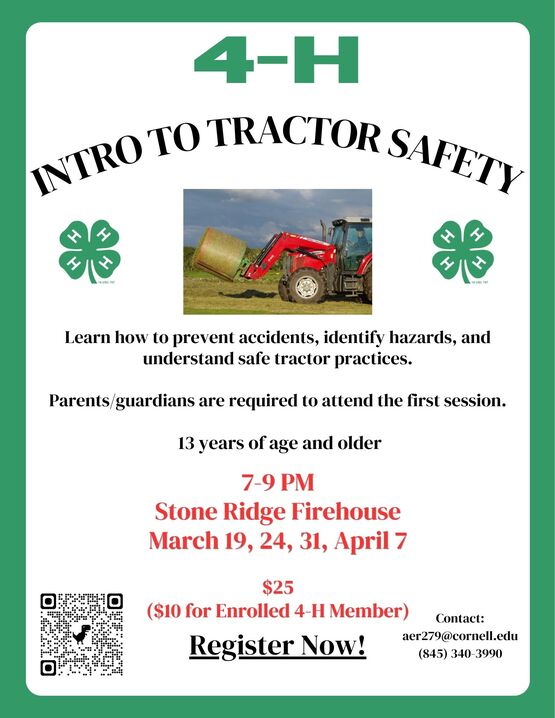
2026 4-H Intro to Tractor Safety!
2026 4-H Heritage Roasters & Geese!
 UPDATE! PER THE DUTCHESS 4-H POULTRY ADVISORY
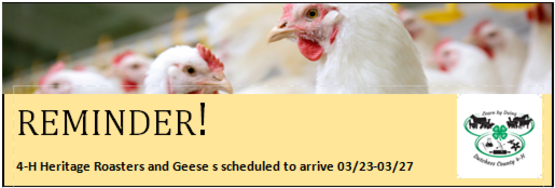
Heritage Roasters and Geese are scheduled to arrive this week! Please make sure you have your brooders ready and print out and complete the majority of the ownership paperwork prior to coming to pick up your birds,
Please complete the following on the ownership form:
-
Owner information and signature section
Animal Species: Chicken
Breed: Delaware
Other ID: N/A
Breeder: Meyer Hatchery, 626 OH-89, Polk, OH 44866
Purchase Price: Roasters $6 each - Geese $41 each
Purchase Date: December 15, 2025
Purchase Weight: N/A
Birth date: March 23, 2026
The other items will be filled out when you pick up your birds.
Most likely birds will be available for pick up Thursday or Friday evening (03/26 & 03/27). Kim Pennock will reach out about pick-up days and times once the birds arrive.